


What is Reddit After All? And Why Does It Matter for Search Visibility?
Ask ChatGPT which running shoe to buy, ask Perplexity which CRM is worth the money, ask Google’s AI Overview whether a piece of software is any good, and there is a strong chance the answer you receive was assembled, at least in part, from anonymous strangers arguing on a forum.
However, Reddit is not an encyclopaedia nor a publisher. It is a pile of pseudonymous threads, moderated by unpaid volunteers, governed by norms rather than editorial standards. Yet, Google paid roughly sixty million dollars a year for gaining access to it, OpenAI signed its own agreement, and Reddit’s chief legal officer now describes the platform as the most commonly cited source in AI-generated answers.
How did this happen? To answer this question and understand how Reddit grew to become this ultra-important source for LLMs, we got to step far, far back (no, not the Stone Age!)
How it all started
Reddit was founded in June 2005 by Steve Huffman and Alexis Ohanian, both freshly graduated from the University of Virginia. They had pitched Paul Graham a mobile food-ordering app, been rejected, and been invited back with a different idea.
The founding premise was simple: build a site where readers decide what appears on the front page. Submissions are voted up or down by the community. Comments arrived in December 2005. A merger with Aaron Swartz’s Infogami followed shortly after, bringing a rewritten codebase and a third co-founder into the mix.
Two structural choices from that period explain almost everything that came later.
Pseudonymity brings honesty
Reddit accounts are detached from real identity. That has obvious costs, and Reddit has spent much of its history paying them. It also has a specific benefit: people say things under a throwaway username that they would never put on LinkedIn. Honest reports of side effects, salary numbers, product failures, regret over a purchase. This is exactly the class of information that marketing content systematically suppresses.
Subreddits as delegated governance
One of the best things Reddit did was to not try to moderate its use centrally. It handed communities their own rules, their own moderators and their own culture. Over 100,000 active communities now operate this way. The result is a corpus that is not one undifferentiated forum but thousands of small, self-policing knowledge bases, each with its own tolerance for self-promotion, low-effort posts and undisclosed advertising.
Ownership changed repeatedly. Condé Nast acquired Reddit on 31 October 2006 for a reported ten million dollars, then spun it out in September 2011 as an independent subsidiary of parent company Advance Publications (Seattle Times, 2024). Reddit listed on the New York Stock Exchange in March 2024. Through all of it, the underlying mechanics stayed intact.
Data that became the product
At some point, Reddit realised that it was sitting on top of a goldmine.
On 18 April 2023, Reddit announced it would begin charging for API access, a resource that had been free since 2008. The stated rate was $0.24 per 1,000 API calls, effective 1 July. Christian Selig, developer of the popular third-party client Apollo, calculated that this would cost him roughly twenty million dollars a year, and announced Apollo would shut down (Variety, 2023).
The response was the largest coordinated protest in the platform’s history. Between 12 and 14 June 2023, more than 8,000 subreddits went private or read-only, including some of the largest communities on the site. Tens of thousands of moderators participated. Reddit itself went down for around three hours under the load (TechCrunch, 2023; Ars Technica, 2023).
The justification Huffman offered was simple. Reddit needed to be self-sustaining and could no longer subsidise commercial entities requiring large-scale data use. The reference to language models trained on Reddit data was explicit. The API fight was not really about third-party apps. It was about establishing that Reddit’s corpus was a licensable asset rather than a public utility.
Two events in 2024 confirmed the thesis. In February, on the same day it filed for its IPO, Reddit announced a content licensing agreement with Google reported at roughly sixty million dollars annually, giving Google real-time structured access to Reddit’s Data API and allowing Reddit content to be displayed more prominently across Google products (NBC News/AP, 2024). In May, Reddit and OpenAI announced a comparable partnership bringing Reddit content into ChatGPT, with OpenAI also becoming an advertising partner (OpenAI, 2024). Reddit’s shares jumped sharply on the news.
Why AI companies need Reddit
A model with the entire indexed web available to it still has to decide what to retrieve and what to cite, and the pattern is consistent enough across independent studies that commercial arrangements alone cannot account for it. These are the four properties that influence it the most:
Format matches retrieval
A Reddit thread is natively a question followed by ranked answers. Retrieval-augmented systems chunk documents and pull passages. A comment that reads “we moved from Tool A to Tool B eighteen months ago, here is what broke and what improved” is a self-contained, extractable passage. A brand landing page rarely is.
Experience is scarce
Language models are trained on an internet in which most commercial content is written by people who have never used the product they are describing. First-hand experience with very specific accounts of using product has become immensely valuable and it’s what most users seek when using Reddit
Community validation is a quality signal
Upvote counts, comment depth, awards and the presence of corrections give a retrieval system something to weight beyond raw text. Where a thread contains an error, there is usually a reply saying so.
Recency
Licensed API access means Google and OpenAI receive Reddit content close to real time. In late 2023, as part of its core updates, Google rolled out a series of ranking changes the industry came to call “hidden gems”, designed to surface first-hand knowledge and personal insight from forums, comments and small blogs (Search Engine Roundtable, 2023).
The effect was dramatic. Glenn Gabe’s analysis found Reddit’s search visibility up 378 percent by Semrush data and 978 percent by Sistrix data following the change, and, crucially, that this was not a Reddit-specific favour: of 97 forums he tracked across verticals, 88 percent saw year-on-year visibility growth above 100 percent (GSQi, 2024).
That is the important point for anyone reading the current AI citation data. Reddit’s prominence in AI answers is the continuation of a search-quality trend that predates AI answers, not a break from it.
What the citation data shows
The headline claim is easy to state and easy to overstate. Reddit is, by most measures, the single most-cited domain in AI-generated answers.
An analysis of 30 million directly cited sources by Peec AI, reported by Search Engine Land in March 2026, ranked Reddit first across ChatGPT, Google AI Mode, Gemini, Perplexity and AI Overviews, ahead of YouTube, LinkedIn, Wikipedia and Forbes. Semrush’s July 2025 study, covering 5,000 randomly selected keywords and more than 150,000 unique citations across four AI search platforms, found Reddit appeared as a leading citation source on every platform tested. Secondary coverage of that dataset put Reddit’s reference share at 40.1 percent, ahead of Wikipedia at 26.3 percent and YouTube at 23.5 percent.
Anyone using these numbers professionally should treat them with more care than they usually receive. Three caveats matter.
Denominators differ wildly
“Share of all citations across millions of domains” and “frequency of appearing at all in a given answer” produce numbers that differ by an order of magnitude from the same underlying data. A figure of 40 percent and a figure of 2 percent can both be accurate descriptions of the same platform.
Engine behaviour is not uniform
Ahrefs’ comparison of AI Mode and AI Overviews found Reddit cited at broadly similar rates in both, while Wikipedia appeared in 28.9 percent of AI Mode citations against 18.1 percent for AI Overviews, and Quora appeared 3.5 times more often in AI Mode (Ahrefs, 2025). Perplexity leans on Reddit far more heavily than ChatGPT does. Aggregate cross-engine figures obscure this.
Volatility is measured in weeks
Semrush’s 13-week study of more than 230,000 prompts found ChatGPT citing Reddit in close to 60 percent of prompt responses in early August 2025, collapsing to around 10 percent by mid-September, with no equivalent drop on AI Mode or Perplexity (Semrush, 2025). This means that the exact figures move constantly.
Why large-scale, low-value manipulation is going nowhere
Everything that makes Reddit valuable to AI systems is also what makes that value unstable, such as:
Manipulation risk
If community consensus is a quality signal, then it’s only natural that it becomes commercially attractive. Over four months in 2024 and 2025, researchers at the University of Zurich ran an experiment on a subreddit, deploying AI-generated personas including a claimed sexual assault survivor and a claimed trauma counsellor, posting 1,783 comments to test whether models could shift opinions. Moderators, who found out only after it had ended, described it as psychological manipulation. Reddit’s chief legal officer Ben Lee called it “deeply wrong on both a moral and legal level” and Reddit banned the associated accounts (Engadget, 2025; Retraction Watch, 2025).
If a small research team could do that undetected for four months, the implications for coordinated commercial use were obvious. Both Reddit’s enforcement systems and the FTC’s endorsement rules push against it, and the reputational downside for a brand caught doing it is severe, but the incentive is there.
The data itself
Reddit sued Anthropic in June 2025 over alleged unauthorised scraping, then sued Perplexity together with data intermediaries SerpApi, Oxylabs and AWM Proxy in October 2025, alleging an operation that accessed nearly three billion search results pages in a single two-week period. Lee described the surrounding market as an industrial-scale “data laundering” economy (Forbes, 2025; Reuters, 2025). Perplexity characterised the suit as a negotiating tactic. These cases will help define whether publicly visible user content is free to read but not free to take.
Reddit no longer wants to be just a supplier
This is the shift most SEO and GEO practitioners are underweighting. Reddit is building the destination itself. Weekly active users of Reddit’s search grew from 60 million to 80 million during 2025, while Reddit Answers, its AI-powered question interface, went from 1 million weekly users in Q1 2025 to 15 million by Q4. Huffman has said the company intends to be an end-to-end search destination (Search Engine Land, 2026; TechCrunch, 2026). Roughly 40 percent of conversations on the platform are commercial in nature, and Reddit says 84 percent of shoppers feel more confident about purchases after researching there.
The referral relationship is deteriorating
In Q2 2026 Reddit reported revenue of 805 million dollars, up 61 percent year on year, and 130.3 million daily active uniques. It also reported that US daily actives slipped sequentially, with Huffman describing search referrals as “choppy” and noting that the shift toward AI Overviews had not yet become a net positive (CNBC, 2026; Reddit Q2 2026 earnings call). In July 2026, the Wall Street Journal reported Reddit was weighing whether to renew the Google licensing agreement at all.
The relationship is therefore not stable. Reddit supplies the data that powers answer engines which reduce the traffic Reddit depends on to generate more data. Huffman’s framing on the Q1 2026 call was blunt: there is no artificial intelligence without actual intelligence, and it comes from Reddit.
What to do then?
What AI systems reward is specific, experiential and verifiable content with external signal of validation. Reddit happens to be the largest reservoir of it. The same properties can be built elsewhere: in expert-authored content with named authorship and real methodology, in earned coverage carrying specific quotable claims, in customer-facing documentation that answers a question directly rather than positioning around it.
Where Reddit itself is concerned, the durable approach is genuine participation in communities where the brand has something useful to contribute. Inauthentic mass tactics do not work, mostly because they carry escalating detection risk, violate FTC endorsement rules, and degrade the exact signal that makes the channel valuable in the first place.
Reddit is the clearest available evidence that what other people say about a brand, in places the brand does not control, now carries more weight in machine-generated answers than what the brand says about itself. It is a channel to be nurtured and influenced, but not gamed.
Sources
- Sequoia Capital, “Reddit ft. Steve Huffman: The Making (and Remaking) of the Front Page of the Internet”, Crucible Moments — https://sequoiacap.com/podcast/crucible-moments-reddit
- Y Combinator, Reddit company profile — https://ycombinator.com/companies/reddit
- The Seattle Times, “Condé Nast’s owners set to reap $1.4 billion windfall from Reddit”, March 2024 — https://www.seattletimes.com/business/conde-nasts-owners-set-to-reap-1-4-billion-windfall-from-reddit/
- Variety, “Reddit Protest: Subreddits Go Dark in Backlash Over API Pricing Move”, June 2023 — https://variety.com/2023/digital/news/reddit-blackout-dark-protest-api-charge-third-party-apps-1235640741/
- TechCrunch, “Thousands of subreddits go dark to protest Reddit’s API pricing”, June 2023 — https://techcrunch.com/2023/06/12/reddit-blackout-8000-subreddits-went-dark-protest-api/
- Trust and Safety Foundation, “The Reddit Blackout of 2023” — https://www.trustandsafetyfoundation.org/blog/blog/the-reddit-blackout-of-2023-moderators-lead-the-charge-for-a-site-wide-protest-of-api-changes
- NBC News / Associated Press, “Reddit strikes $60M deal allowing Google to train AI models on its posts, unveils IPO plans”, February 2024 — https://www.nbcnews.com/tech/tech-news/reddit-strikes-60m-deal-allowing-google-train-ai-models-posts-unveils-rcna140168
- OpenAI, “OpenAI and Reddit Partnership”, May 2024 — https://openai.com/index/openai-and-reddit-partnership/
- Search Engine Roundtable, “Google Search Hidden Gems Ranking Algorithm Rolling Out”, November 2023 — https://www.seroundtable.com/google-search-hidden-gems-ranking-algorithm-36388.html
- GSQi (Glenn Gabe), “Beyond Reddit and Quora: How Google’s Hidden Gems Update Yielded Explosive Growth In Search Visibility For Many Forums”, 2024 — https://www.gsqi.com/marketing-blog/beyond-reddit-and-quora-google-hidden-gems-update-forums-surge/
- Semrush, “How Google’s AI Mode Compares to Traditional Search and Other LLMs”, July 2025 — https://www.semrush.com/blog/ai-mode-comparison-study/
- Semrush, “The Most-Cited Domains in AI: A 3-Month Study”, November 2025 — https://www.semrush.com/blog/most-cited-domains-ai/
- Search Engine Land, “AI search engines cite Reddit, YouTube, and LinkedIn most: Study”, March 2026 — https://searchengineland.com/ai-search-engines-cite-reddit-youtube-and-linkedin-most-study-473138
- TechCrunch, “Reddit looks to AI search as its next big opportunity”, February 2026 — https://techcrunch.com/2026/02/05/reddit-looks-to-ai-search-as-its-next-big-opportunity/
- TechCrunch, “People are finally using Reddit’s search”, May 2026 — https://techcrunch.com/2026/05/01/people-are-finally-using-reddits-search/
- CNBC, “Reddit (RDDT) Q2 2026 earnings report”, July 2026 — https://www.cnbc.com/2026/07/30/reddit-rddt-q2-2026-earnings-report.html
- CNBC, “Reddit stock sinks on report it may not renew Google AI content deal”, July 2026 — https://www.cnbc.com/2026/07/22/reddit-stock-google-ai-content-deal.html

Competitors Appear in AI Answers and You Don’t. Most Gap Audits Will Not Tell You Why
A list is not a diagnosis
Every AI visibility tool now ships a citation gap report. Semrush, Peec, Profound, Scrunch and others will hand you a ranked list of domains that cite your competitor and not you, usually with an impact score attached.
The problem is that two companies with identical gap lists can need completely different work, and the list cannot tell them apart. One is absent because a crawler directive blocks retrieval. One is absent because the source is a competitor’s own customer case study, which no amount of content will ever change. The report looks identical in both cases.
A useful audit does three things a tool report does not. It disambiguates what kind of absence you have. It separates gaps you can close from gaps you cannot. And it treats the result as a hypothesis rather than a cause.
First, disambiguate the absence
“They appear and we don’t” describes at least five different failures, each with a different fix.
Not mentioned at all. Your brand does not appear in the answer text. This is a visibility failure and it is the only one most teams measure.
Mentioned but not cited. The model names you and links to someone else’s page about you. Your competitor’s comparison post is doing your positioning. This is an attribution failure, and the fix is a page worth citing, not more mentions.
Cited on one engine, absent on another. Only about 11% of cited domains appear across both ChatGPT and Perplexity for the same query, and roughly 71% of cited sources show up on a single platform. Engine-specific absence is normal, not a crisis, and diagnosing it requires per-engine data.
Present but positioned badly. You appear as the cheap option, the legacy option, or the one with the caveat. Share of voice looks fine. The answer is still costing you the deal.
Present in branded prompts, absent in category prompts. The model knows who you are and does not consider you a member of the category. This is the most expensive failure and the slowest to fix.
Report these separately or the audit averages them into something meaningless. Note too that share of voice, mention rate and citation rate use different denominators, so a brand can move on one and not the others.
Then classify by eligibility, not by impact score
This is the step that saves a quarter of wasted work.
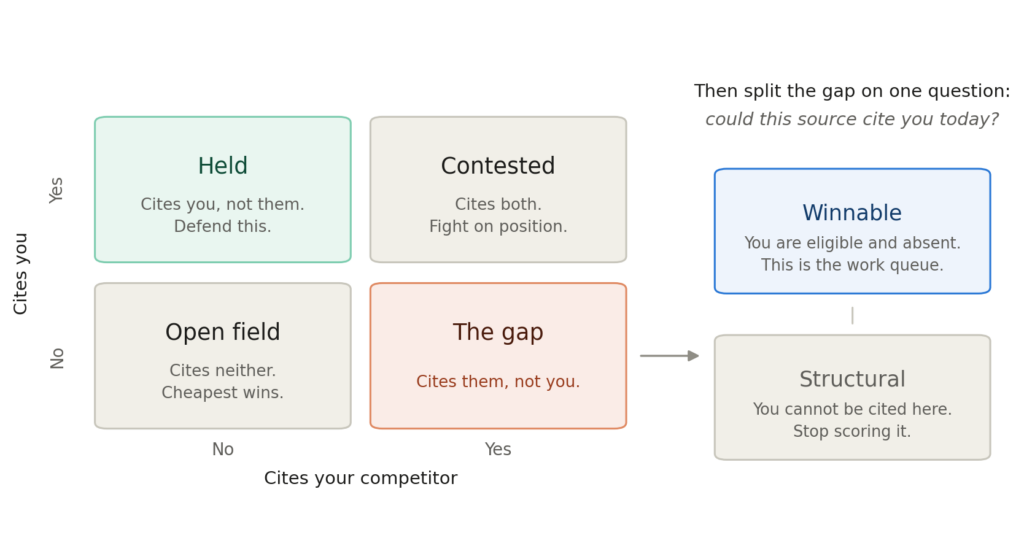
Figure 1. Two stage classification. The quadrant split is the easy part; the eligibility split on the gap quadrant is what stops a team spending a quarter on sources that were never open to them.
Source: Storylake framework, created internally
Sort every source into four quadrants: cites both of you, cites them only, cites you only, cites neither. Then take the “cites them only” quadrant, which is your actual gap, and split it again on a question no tool asks.
Could this source cite you, in principle, today?
Winnable gaps are sources where you are eligible and simply absent. A category review site you have no profile on. A comparison listicle that omits you. A forum thread where nobody mentioned you. This is your work queue.
Structural gaps are sources where you are not eligible and cannot become eligible through content. The competitor’s own domain. Their customer’s case study. A partner directory that requires a certification you do not hold. A publisher operating under a licensing deal. These will sit at the top of an impact-scored gap list forever, because they are high value and permanently closed.
The eligibility test takes about thirty seconds per source and a human can do it. It is the cheapest filter in the whole method and almost nobody applies it.
The “cites you only” quadrant is worth as much as the gap. It tells you what already works, and it is the thing to defend when a competitor runs this audit on you.
Rigour the tool reports skip
Never aggregate engines. Given how little overlap exists between platforms, a combined gap list averages incompatible retrieval systems.
Work at URL level. On ChatGPT, 99% of Reddit citations point to individual threads rather than subreddit pages or brand profiles. “Get on Reddit” is not an action. “This thread” is.
Run each prompt multiple times. Outputs are probabilistic, so a single run tells you what happened once. Five runs per prompt per engine is a reasonable floor.
Expect brutal concentration, and take it as good news. One agency reported that for a B2B client tracking more than 300 prompts across thousands of responses, two Reddit threads carried the vast majority of citations. If your gap list has four hundred rows, most of them do not matter.
Diagnosing cause, and the denominator trap
Once you have a winnable gap, work through causes cheapest first.
Crawler access. The cheapest check and the most commonly missed. Confirm retrieval agents can actually fetch your pages, and distinguish training crawlers such as GPTBot from live retrieval agents such as OAI-SearchBot and ChatGPT-User, because blanket rules catch both. Test from outside using the agent’s user agent string and confirm you get a full page back.
But here is where the audit will lie to you if you are careless.
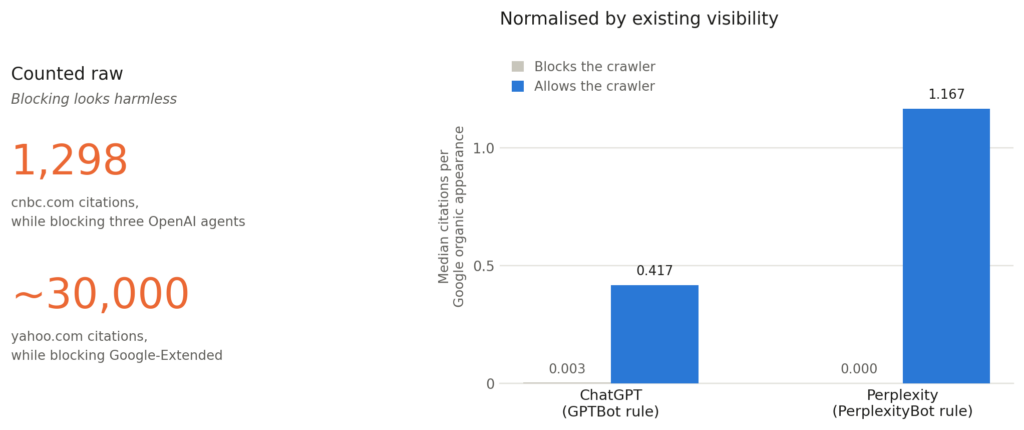
Figure 2. The same question, two competent studies, opposite answers. The difference is the denominator: raw counts reward size, normalised rates reveal the effect.
Source: Left: BuzzStream, 4 million citations across 3,600 prompts, March 2026, via PPC Land. Right: Cloro, 1,058 domains, July 2026.
In March 2026, BuzzStream analysed 4 million citations across 3,600 prompts and concluded that blocking crawlers rarely stops AI systems citing you. Their evidence was concrete: cnbc.com blocks three OpenAI agents simultaneously and still appeared 1,298 times in the dataset. Yahoo blocks Google-Extended and appeared close to 30,000 times.
In July 2026, Cloro cross-referenced crawler rules against citations for 1,058 prominent domains and reached the opposite conclusion. The median GPTBot-blocking domain earned 0.003 ChatGPT citations per Google organic appearance, against 0.417 for domains that allow it. Sites blocking PerplexityBot showed a median Perplexity propensity of zero, against 1.167 for the rest. Blocking a provider’s own crawler depressed citations in that provider’s engine specifically.
Both studies are competently executed. They disagree because BuzzStream counted raw citations and Cloro normalised by how visible each domain already was. Enormous domains get cited despite blocking, because they are enormous. Normalise for prominence and the effect reappears.
Your gap audit has exactly the same failure mode. If you count raw citations, you will conclude that big competitors win because they are big, which is true and useless. Normalise by something (prompts entered, pages eligible, existing organic presence) or you are measuring size.
Lexical match. Cornell researchers found that retrieval systems often use lexical similarity to the query as a proxy for accuracy, so text that reads like the question gets treated as though it answers it. Compare the cited competitor page against your equivalent. Does theirs mirror the phrasing buyers actually use, while yours uses internal product language?
Verification signals. Research on AI-cited health sources found that publishers without inherent institutional authority compensate through visible review statements, structured data, content depth and recency. Check whether the cited page carries signals yours lacks.
Commercial arrangement. Some sources appear because of a licensing agreement rather than merit. That is a structural gap wearing a winnable disguise.
What the audit cannot tell you
A gap is a correlation. Observing that a competitor is cited by a review site you are absent from does not establish that getting listed would produce citations. Retrieval timing varies, and competitors ship many things at once.
So treat every diagnosed cause as a hypothesis with a test attached: change one thing, hold the prompt set constant, re-baseline after a fixed interval, and accept that some tests come back null. Re-run the baseline rather than comparing against an old one, because retrieval shifts underneath you. Semrush tracking recorded ChatGPT’s Reddit citations falling from roughly 60% of prompt responses to around 10% in mid September 2025 before recovering. A delta measured across that window would have been pure noise.
The audit spec
Reproducible version, one category, one competitor set.
- Prompt set. 40 to 60 prompts across three tiers: category (no brands named), comparison (“X versus Y”, “alternatives to X”), and branded. Tier them explicitly, because absence in category prompts and absence in branded prompts are different diseases.
- Engines. Three minimum, run and reported separately. Never merged.
- Runs. 5 per prompt per engine. Fresh sessions, memory and personalisation off, locale fixed and logged, timestamped to the hour, model version recorded where exposed.
- Capture. Full response text verbatim, every cited URL, and brand mentions with position in the answer. URL level, not domain level.
- Classify. Every source into one of four quadrants. Split the gap quadrant into winnable and structural using the eligibility test.
- Label the absence type. One of the five failure modes per prompt, not a single visibility score.
- Diagnose. For the top winnable gaps only, work the cause ladder: crawler access, lexical match, verification signals, commercial arrangement.
- Normalise before comparing. Choose a denominator and state it on every chart.
- Test. One change, one hypothesis, fixed interval, re-baselined.
The output is not a visibility score. It is a short list of specific URLs, each with a named absence type, an eligibility verdict, and a cause hypothesis you can falsify. That is considerably less impressive on a slide and considerably more useful on a Monday.
By André Franco, Senior SEO/GEO consultant at Textbroker

Your Brand Doesn’t Appear in ChatGPT Answers: Why?
A four-way self-diagnosis before you call anyone
“Our brand doesn’t show up when people ask ChatGPT for a recommendation” is not one problem. It’s four.
They look identical from the outside. The same blank space where your name should be. However, on the inside, each has a different cause and a different fix. Pouring months into content when your real problem is a firewall rule is a waste. So is rewriting your robots.txt when the model simply doesn’t know your company exists.
Before you hire anyone (including us), you can find out which of the four you’re dealing with in about ten minutes. You need a ChatGPT account where you can toggle web search on and off, and the willingness to ask it the questions your buyers actually ask. Work down the tree in order. Each check clears one layer before you move to the next, so you never end up fixing the wrong thing.
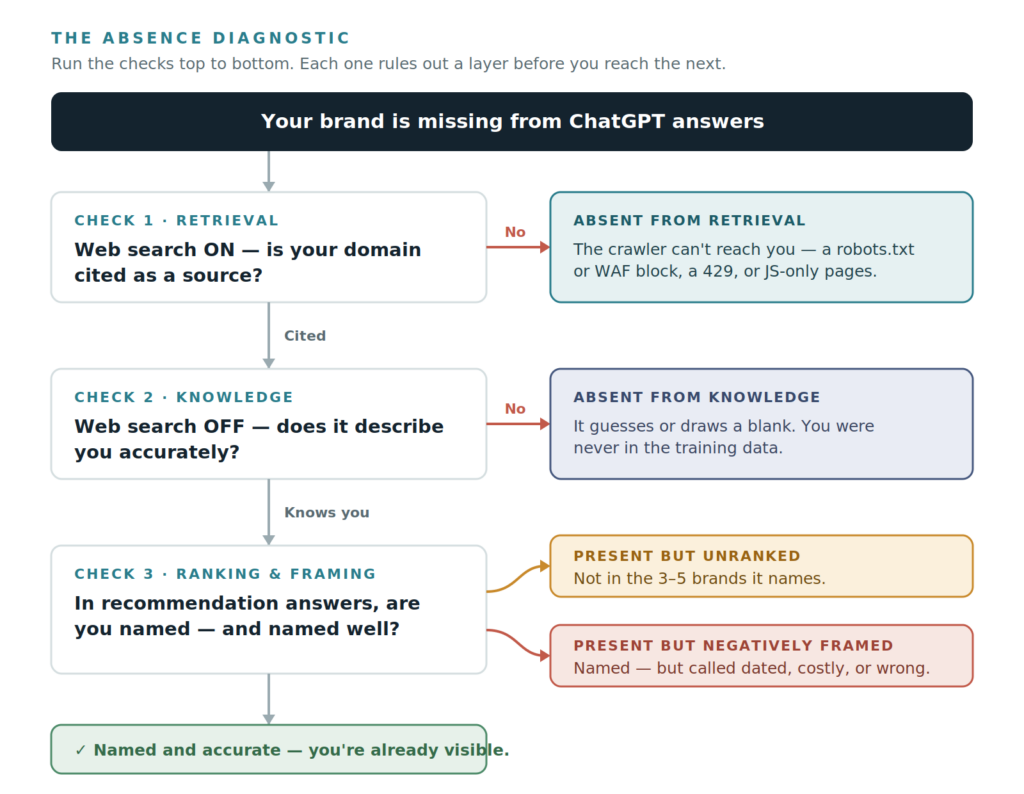
Figure 1: The absence diagnostic. Run the three checks in order; each rules out a layer before you reach the next. Source: Storylake
Check 1: Can it even reach you?
Turn web search on. Ask the real buyer query (e.g. “best [category] for [use case]”) and read the citations underneath the answer. If your domain never appears as a source across any relevant prompt, the model isn’t choosing to leave you out. It can’t reach you. This is plumbing, and it’s the most common cause by a wide margin.
ChatGPT reaches sites through three separate OpenAI crawlers, each with a different job: GPTBot handles model training, OAI-SearchBot builds the search index behind citations, and ChatGPT-User fetches a page live when the model needs it. The one that governs whether you appear in search answers is OAI-SearchBot — and OpenAI’s own publisher guidance is blunt: block it and you won’t show up in ChatGPT search. Plenty of sites block it by accident, a leftover from the 2023 reflex to bar every AI bot.
An open robots.txt won’t save you if your firewall does the blocking instead. The classic trap: the crawler is technically allowed, but a Cloudflare or WAF rule returns 429 Too Many Requests, so OpenAI quietly drops you.. Two more culprits are near-universal: OAI-SearchBot and ChatGPT-User don’t reliably execute JavaScript, so content that renders only client-side is invisible to them; and noindex or nosnippet tags make a page impossible to quote.
Where retrieval actually pulls from is deliberately murk. OpenAI blends its own index with licensed search partners, and the Bing-versus-Google mix has shifted enough that any confident “it’s just Bing” claim is now outdated. The practical version is simpler: allow OAI-SearchBot and ChatGPT-User, clear the WAF and rate-limit traps, server-render your key pages, and make sure you’re indexed in both Bing and Google. One reassuring nuance: being indexed matters far more than ranking first. This is the one branch where you can move the needle in a day.
Check 2: Does it know you at all?
If you are getting retrieved but still losing, turn web search off and ask: “What is [your brand] and what does it do?” If it invents an answer, confuses you with a competitor, or admits it doesn’t know, you’re not in the model’s parametric memory.
This is the hardest gap to close, because you can’t optimize your own website into it. Models learn brands from the wider web, and the concentration is stark: in Ahrefs’ analysis of 75,000 brands, Reddit, Wikipedia, Amazon, Forbes and Business Insider rank among ChatGPT’s most-cited domains, i.e., the places the model reads to decide who you are. The same research found a brutal winner-takes-all curve in Google’s AI Overviews: 26% of brands had zero mentions, and any brand sitting in the bottom half of web mentions was, in Ahrefs’ words, essentially invisible. Brands in the top quartile of web mentions averaged 169 AI Overview mentions, more than ten times the quartile below them.
So the fix is a slow signal-density game: earn mentions where the models actually read (e.g. editorial coverage, review platforms, Reddit, reference-grade sources) and future training runs pick you up. It also explains why Check 1 matters so much in the meantime. Retrieval is your only route into today’s answers while the training data catches up.
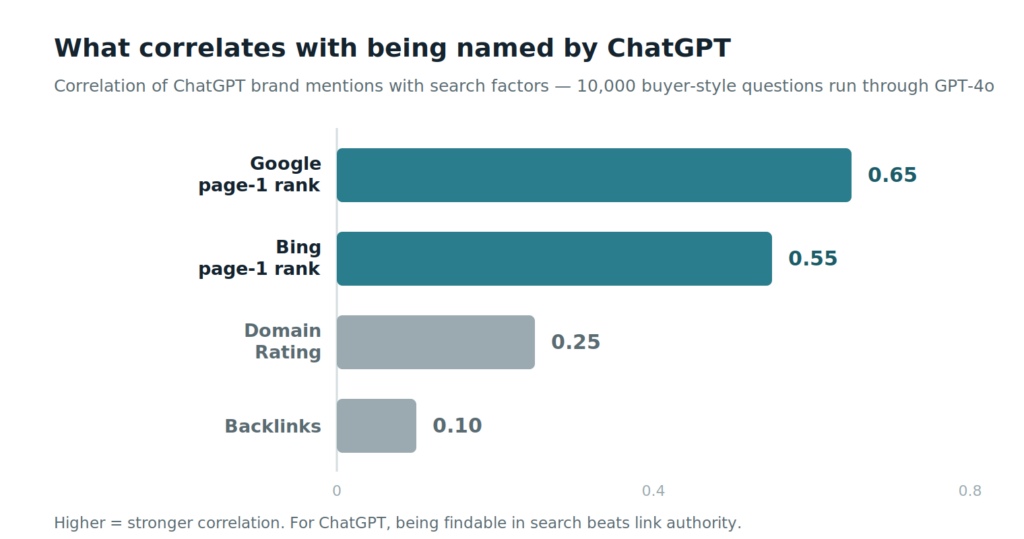
Figure 2: For ChatGPT specifically, ranking on page one of Google (~0.65) and Bing (~0.55) correlates with brand mentions far more than domain rating or backlinks.
Source: Seer Interactive, “What Drives Brand Mentions in AI Answers,” January 2025 (10,000 questions via the GPT-4o API).
Check 3: Are you named, and named well?
If the model can retrieve you and knows who you are but you’re still absent from the recommendation, the problem is competitive and splits in two smaller issues:
Present but unranked
LLMs surface only a handful of brands per answer, and getting onto that short list is the game. The encouraging news for ChatGPT specifically: it’s more meritocratic than you’d expect.
When Seer Interactive ran 10,000 buyer-style questions through the GPT-4o API, the strongest correlate of being named wasn’t domain authority or backlinks, it was ranking on page one of Google (~0.65) and Bing (~0.55). ChatGPT tends to name brands that are already findable in ordinary search, not the ones with the biggest link profiles.
On the content side, the Princeton-led GEO study (KDD 2024, with Georgia Tech, IIT Delhi and the Allen Institute for AI) tested nine tactics across 10,000 queries and found the single most effective one was adding specific statistics, which lifted visibility in generative answers by up to roughly 40%. Ahrefs’ AI Overviews data points the same direction: branded web mentions out-predicted backlinks about three to one. The through-line is consistent: get findable in search, get discussed off-site, and be specific enough to quote.
Present but negatively framed
Sometimes you’re named, and it hurts. The model calls you “expensive,” “hard to set up,” or references a feature you retired two years ago.
Here is the uncomfortable finding: When Ahrefs invented a fake brand and seeded the web with three conflicting stories about it, most assistants swallowed the fiction: Gemini and Perplexity repeated the planted falsehoods in 37–39% of answers. ChatGPT held up best — under 7% — because it leaned on the brand’s official FAQ in 84% of its answers. The lesson lands hard: when forced to choose between a vague truth and a specific fiction, AI picked the specific fiction almost every time. If your own pages say “we don’t disclose pricing” and a competitor’s comparison names a number, the number wins.
That points straight to the fix. Fill every gap with specific, official content: an FAQ that states plainly what’s true and false (“we’ve never been acquired”), backed by real dates, numbers and schema markup. Claim specific superlatives (e.g. “best for [use case],” “fastest at [metric]”) rather than generic “industry-leading” language that AI averages into noise. Then monitor how each model describes you, because there’s no single “AI index”: the version of you in Perplexity can differ from the one in ChatGPT, and you fix each at its own source.
The pattern under all four: specificity wins
Read across every credible study and one thread runs through all of them. Adding statistics beat every other content tactic. Specific fiction beat vague truth. Findable, quotable pages beat big backlink profiles. The brands that win AI answers are always the most specific credible source on the question being asked. Vagueness is the real enemy: leave a gap, and the model fills it with whoever was more precise, even when they’re wrong.
The same empty space has four causes, and they run on different clocks. A retrieval block clears in a day. A knowledge gap takes quarters. Ranking and framing sit in between, and both reward the same durable work: being genuinely findable, quotable, and specific in the places these models read.
Run the three checks in order and you’ll know which problem you’re actually solving before you spend a dollar on the wrong one. If you get to the bottom and want a second pair of eyes on the fix. That’s where we, Storylake, come in to help you out.
By André Franco, Senior SEO/GEO consultant at Textbroker
Why AI and Forum Sentiment Dictate Your Brand’s Visibility
Traditional corporate PR was built for a web that no longer exists. For years, brands controlled their public image via polished press releases, structured ad campaigns, and heavily moderated comment sections. Today, however, user-generated platforms, most notably Reddit, have fundamentally disrupted the digital reputation management playbook.
As a software developer by trade and product owner, I look at sentiment analysis not as a metric for the social media team to track customer satisfaction, but as primary source data. Search engines and Large Language Models (LLMs) use this unstructured forum data to programmatically define your brand to the public. If your brand’s Reddit presence is unmanaged, your entire search visibility strategy faces a systemic engineering risk.
To understand why this happens, we have to look at the technical architecture behind modern search and see how algorithms crawl, weight, and synthesize forum data and how we built transparent.ai to solve it.
The Technical Infrastructure of Modern Search: SEO, AEO, and GEO
The rise of generative AI has split search engine optimization into three distinct, highly technical frontiers. All three rely heavily on structured and unstructured forum data.
[Negative Reddit Sentiment]
▼
[Search Engines Rank Negative Thread via “Information Gain” Signals]
▼
[LLMs Train on Licensed Data / Web Crawls of Highly Upvoted Threads]
▼
[AI Engines (Perplexity, AI Overviews) Synthesize Negative Brand Summaries]
1. SEO (Search Engine Optimization)
While traditional SEO focuses on ranking blue links on a Search Engine Results Page (SERP), algorithmic updates have shifted toward prioritizing first-person, authentic human experiences. Search engines actively surface Reddit threads for high-intent queries because they represent authentic user consensus over optimized corporate blogs.
2. AEO (Answer Engine Optimization)
AEO focuses on structuring and managing your digital footprint so that voice assistants (e.g., Siri, Alexa) and direct-answer boxes (Google’s Featured Snippets) pull your brand as the single, definitive answer to a user query.
3. GEO (Generative Engine Optimization)
The newest frontier. GEO involves optimizing your brand presence so that generative AI search layers (Google’s AI Overviews, Perplexity, OpenAI Search) synthesize positive, accurate summaries of your brand and cite your digital assets as a trusted source.
Why AI Core Models Prioritize Reddit Data
In an internet flooded with automated, programmatically generated content farm sites, search engines face a massive data quality problem. To counter this, algorithmic architecture heavily weights platforms that showcase real-world experience.
Furthermore, major AI infrastructure companies have established direct, multi-million dollar data-licensing partnerships giving them structured, real-time access to Reddit’s data pipeline. This means Reddit isn’t just being indexed for standard search. It feeds AI systems through two distinct channels: one immediate, one permanent.
If a technical issue, product flaw, or customer complaint goes viral on a subreddit, the impact unfolds in two stages:
Stage 1: Retrieval (days)
AI search layers like Perplexity, Google’s AI Overviews, and ChatGPT’s web search don’t wait for a training run. They fetch and cite live web content at query time, and highly upvoted Reddit threads rank near the top of what they retrieve. A thread that blew up on Tuesday can appear, synthesized as fact, in an AI-generated brand summary by Friday.
Stage 2: Training (permanent)
In subsequent training runs, that same thread becomes part of the foundational data the next model generation learns from. What started as a retrievable citation hardens into the model’s baseline “knowledge” of your brand, no longer linked to a source, no longer contestable, just stated.
The next time an enterprise buyer asks an AI engine for a product comparison, the flaw surfaces either way: first as a cited retrieval result, later as an unattributed, synthesized fact.
Technical Indicators Traditional Tools Miss
When configuring an automated sentiment analysis tool, traditional metrics like simple mention counting or basic NLP (Natural Language Processing) polarity scores are insufficient. Most visibility tools on the market only track the visible surface layer:
- Visible Citations: Seeing when and where ChatGPT, Gemini, or Perplexity links to your domain.
- Share of Voice: Benchmarking visibility against competitors.
- Output Sentiment & Source URLs: Analyzing the AI’s generated description and tracking which of your website pages it prefers to reference.
- Static Scoring: Calculating a real-time AI Visibility or Brand Sentiment score.
While useful, tracking AI visibility and sentiment without taking action is just reporting. It tells you that you are losing but doesn’t stop the bleed. To fix this, a tool must evaluate the specific algorithmic indicators that search and AI engines use to parse data before it becomes a model weight.
Upvote Weighting as Algorithmic Trust
Unlike platforms where a post’s visibility is tied entirely to a chronological feed, Reddit operates on community-voted consensus. For a generative engine or a search crawler, highly upvoted threads are disproportionately surfaced and sampled. So it’s a reasonable guess to say that LLMs view high upvote counts in key subreddits relevant to the topic as verified community consensus.
The “Information Gain” Score
Modern search algorithms utilize a core patent concept known as Information Gain. If multiple websites publish identical information, the search engine assigns low value to subsequent pages. Instead, it hunts for unique, net-new insights, data points, or edge-case anomalies. Reddit is an information gain engine. Search engine crawlers are programmatically biased to surface these threads over standard corporate marketing copy.
The Zero-Click Search Vector
In the GEO and AEO landscape, users increasingly obtain answers directly inside the AI chat interface without clicking a link. When a user prompts an engine with: “What are the common architecture issues with [Your Brand]?”, the AI queries its training database, parses the top upvoted Reddit threads, and outputs a synthesized summary. Your analysis tool must treat Reddit data not merely as public sentiment, but as the exact copy the AI will use to draft your brand’s public-facing summary.
How transparent.ai Solves the Root Cause
We built transparent.ai because we realized that monitoring the output of an AI engine is too late. The damage to your ground-truth data layer is already done.
We combine AI Visibility analytics with real-time brand sentiment tracking, but we go one step deeper: we help you align actions across your engineering, product, and support teams to act on data in real time.
+——————————————————————-+
| TRANSPARENT.AI |
+——————————————————————-+
| [Uncover Pre-Citation Layer] –> [Resolve Friction] –> [Route to Exps] |
+——————————————————————-+
▼
[Shape the AI’s Ground Truth]
Our platform shifts your workflow from reactive monitoring to proactive solution architecture:
- Uncover the Pre-Citation Layer: Most tools only show you what AI engines already cite. We reveal the layer beneath: the Reddit threads and forum discussions that shape the AI’s opinion of your brand before they ever surface in an AI Overview. By the time a thread is cited, it’s already been retrieved, weighted, and synthesized dozens of times invisibly.
- Resolve User Frictions Early: Our engine flags rising upvote velocity and high-information-gain bugs early, allowing your team to debug and help users before these issues become permanent, ingested AI “facts.”
- Mobilize Internal Experts Openly: Instead of leaving responses to a marketing team, transparent.ai routes complex community, technical, or product questions directly to your engineering or support queues, so the people who actually built the product can answer, clearly identified as company representatives. Communities reward verified expertise; they punish anonymous PR.
Moving From Reporting to Action
To protect your brand’s SEO, GEO, and AEO posture, your tracking architecture should monitor high-intent search variations that mirror search engine queries (e.g., [Brand] + review, [Brand] + bug).
Because search engines value balanced data, a completely sterile, perfectly positive presence looks anomalous and indicates astroturfing. True community advocacy is nuanced. Technical or support interventions should happen directly inside the threads to resolve issues transparently, creating high-value data for future AI crawls.
By mobilizing your developers, power users, and verified customers to document solutions openly, you provide stable, favorable training data for the LLMs querying your brand.
Understanding your brand’s digital footprint across the data sources that train today’s AI is no longer optional. If you want to stop just acknowledging your score and actually start improving it, you need to monitor the data layer that matters.
Take a look at your data and see what the models are actually learning about your brand.
By David Moors, Product Owner at Textbroker

Share of Model: A Definition and a Measurement Protocol You Can Reproduce
Share of Model is becoming the headline metric of AI visibility, and it is being measured badly. Vendors compute it differently, definitions shift between decks, and single screenshots of a ChatGPT answer are presented as evidence of presence or absence. This article does two things: it states a clean definition, and it sets out a measurement protocol that anyone, client, competitor or sceptic, can reproduce without our tooling. Transparency about method is the only thing that makes a metric trustworthy, and we would rather you check our numbers than take them on faith.
What is Share of Model?
Share of Model is the percentage of AI generated answers, across a defined prompt set, a defined set of models and a defined time window, in which your brand appears. It is analogous to share of voice in media measurement: not a rank, but a rate of presence in the conversations that matter to you. A rigorous version always names its three parameters, because a Share of Model figure without a prompt set, a model list and a date range is not a measurement, it is an anecdote.
Expressed as a formula: Share of Model equals the number of answers mentioning the brand, divided by the total number of answers generated, multiplied by one hundred. The refinements that follow, recommendation weighting, position weighting, sentiment, are useful, but they are refinements. Get the base rate right first.
Why a single screenshot proves nothing
Large language models are probabilistic. Ask the same model the same question twice and you will often receive different answers, with different brands in them. On top of that variance sits volatility in the retrieval layer: Semrush’s tracking recorded ChatGPT citing Reddit in close to sixty per cent of responses in August 2025 and around ten per cent six weeks later, an enormous shift in the underlying source pool in under two months. A metric read from one run, on one day, on one model, captures noise and presents it as signal.
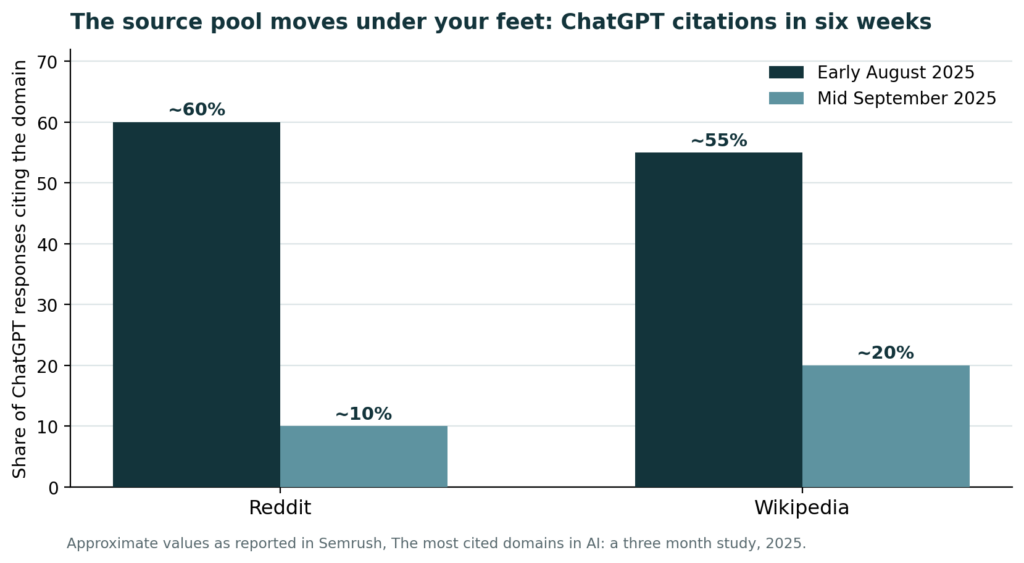
Source: SEMrush. Share of ChatGPT responses citing each domain, six weeks apart. Approximate values as reported in Semrush’s three month study of the most cited domains in AI, 2025.
The protocol
Step one: construct the prompt set
Write twenty to fifty prompts that reflect how real buyers ask. Cover three intent types: category discovery (best platforms for X), comparison (X versus Y for mid market teams) and problem framing (we struggle with X, what should we use). Phrase them the way people speak, not the way keyword tools suggest; analyses of user behaviour consistently show AI prompts running far longer than search queries, with HubSpot’s research putting the average ChatGPT prompt at around twenty three words against three to four for a Google search. Freeze the set. Every future measurement uses the same prompts, or the trend line means nothing.
Step two: choose the models and surfaces
Measure at minimum across ChatGPT, Perplexity, Gemini and Google’s AI Overviews, and add Claude if your category skews professional. The engines draw on visibly different source pools; published citation analyses find only a small minority of domains cited by both ChatGPT and Perplexity. A brand can hold a strong position in one engine and be absent from another, so a single engine number is not a Share of Model, it is a share of that model.
Step three: decide the number of runs
Run each prompt multiple times per engine, in fresh sessions. We use ten runs per prompt per engine as a working floor, thirty where budgets allow. The correct number is the one at which your figure stabilises: if five additional runs move the result by more than a couple of percentage points, you have not yet measured it. Record everything, raw answers included, at collection time.
Step four: classify with written rules
Before reading a single answer, write down what counts. We distinguish three levels. A mention: the brand appears in the answer text. A recommendation: the brand is offered as a suggested choice for the asked question. A citation: the brand’s own domain is linked as a source. These are different assets; published platform analyses find brands are frequently mentioned by ChatGPT without any link, while the citation often goes to a third party review site or forum thread discussing the brand. Decide in advance how hedged answers, refusals and follow up clarifications are scored, and apply the rules mechanically.
Step five: score and weight
Report the simple presence rate first, then the recommendation rate as the stricter and more commercially honest figure. If you weight by position in the answer, say so and publish the weights; the precedent here is the Princeton GEO benchmark, which introduced position adjusted metrics for exactly this reason. Report each engine separately as well as the blended figure, because the blend hides the differences that tell you where to act.
Step six: report like a researcher, not a salesperson
Publish the prompt set, the run counts, the dates and the classification rules alongside the numbers. Show the range across runs, not just the mean. Repeat the measurement on a fixed cadence, monthly is realistic, and report movement only when it exceeds the noise you have already documented. A ten point swing means nothing if your own variance chart shows twelve point swings between Tuesdays.
What published measurements already show
The protocol matters because the engines genuinely behave differently, and the published data proves it. OtterlyAI’s analysis of over one million citations collected in January and February 2026 found the share of citations pointing to brand owned domains varies sharply by platform, with community sites such as Reddit and Quora taking a slightly larger share than brands overall.
| Platform | Citations to brand owned domains |
| Google AI Overviews | 59.8% |
| ChatGPT | 44.7% |
| Perplexity | 28.9% |
Source: OtterlyAI, analysis of one million plus AI citations, January to February 2026.
A brand can look healthy in Google AI Overviews, where domain authority still carries weight, while remaining invisible in Perplexity, where the citation pool runs through community discussion. A blended average would hide exactly the difference that tells you where to act, which is why the protocol insists on reporting each engine separately.
What this metric cannot tell you
Share of Model measures presence, not persuasion. It does not tell you whether the mention was accurate, favourable or current, which is why we pair it with sentiment sampling. It is also corrupted easily: personalisation and memory features mean a logged in account that has discussed your brand before will inflate your numbers, so collection must use clean sessions. Geography and language matter too, since answers differ across regions and an English only measurement says nothing about your visibility in Spanish or German. Name these limits in every report. A metric whose weaknesses are documented is worth more than one that claims none.
By André Franco, Senior SEO/GEO consultant at Textbroker

How Generative Engine Optimization Actually Works: A Mechanism Level Guide
Most explanations of generative engine optimisation describe outcomes. Get cited. Be the answer. Win the recommendation. Very few describe the machinery that produces those outcomes, which is a problem, because you cannot influence a system you do not understand. This guide walks through what actually happens between a person typing a question into ChatGPT, Perplexity or Google’s AI Mode and a brand appearing, or not appearing, in the answer. At each stage, we name the intervention available to you.
Our starting premise at Storylake is simple: AI systems do not rank websites. They cite sources they trust. Everything below is an explanation of how that trust is established, mechanically, stage by stage.
What is generative engine optimisation?
Generative engine optimisation, usually shortened to GEO, is the practice of increasing the likelihood that an AI system mentions, recommends or cites your brand when it generates an answer. The term comes from a 2024 academic paper by Aggarwal and colleagues at Princeton, presented at the KDD conference, which tested which content changes measurably improve visibility inside AI generated answers. It differs from classic SEO in what it optimises for: not a position on a results page, but inclusion in a synthesised answer.
You will also see the phrase answer engine optimisation, or AEO. The cleanest way to separate the two: AEO is about structuring content so that machines can extract an answer from it, while GEO is the broader discipline of earning presence across everything an AI system reads, including sources you do not own. AEO is a subset of GEO. Both sit on top of SEO, because a page must still be found before it can be read.
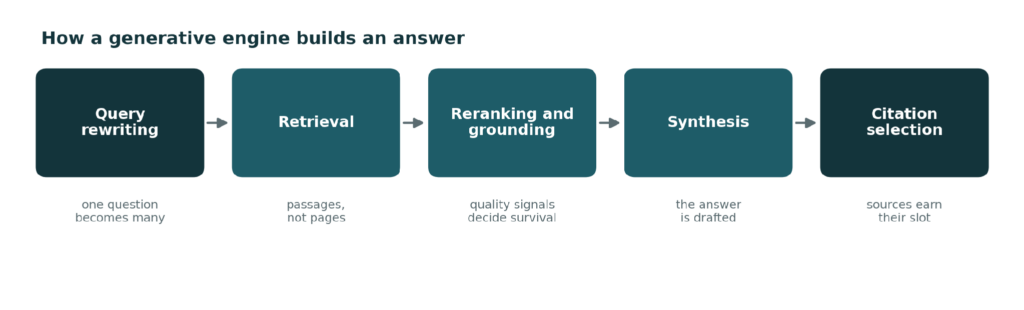
Source: Aggarwal et al. (KDD 2024, Figure 2)
Stage one: the question is rewritten before anything is searched
When a person asks an AI system a complex question, the system rarely searches for that question. It decomposes it. Google calls this query fan out, and has described it openly: AI Mode issues multiple related searches at once, across subtopics and data sources, before it writes a word. A patent application filed by Google, US20240289407A1, describes a system in which a language model generates a set of synthetic queries that explore different facets of the original question. Industry analyses consistently observe a single seed question expanding into roughly eight to twelve subqueries covering comparisons, specifications, pricing, alternatives and likely follow ups.
The practical consequence is significant. The keyword you rank for is not the only string the engine searches. Content can be pulled into an answer because it happened to be the best response to one hidden subquery, which is why pages from deep in traditional results sometimes surface in AI answers. Your intervention here: map the subquestions that surround your topic and answer each one explicitly, rather than writing one page that gestures at all of them.
Stage two: retrieval happens at passage level, not page level
The expanded queries are run against an index, but modern retrieval does not match keywords to pages. Queries and content are converted into vector embeddings, mathematical representations of meaning, and the system pulls the passages that sit closest to each subquery in that space. The unit of competition is a chunk of text, typically a few hundred words, not your domain and not your page.
This is why we tell clients that a brilliant answer buried in paragraph nine is invisible. Your intervention: make every section of a page independently useful. A heading that states the question, followed by two or three sentences that answer it completely, followed by the supporting evidence. If a two hundred word slice of your page cannot stand alone, it will struggle to be retrieved.
Stage three: reranking and grounding decide what survives
Retrieval casts a wide net. A second pass then reranks the retrieved passages for relevance, quality and trustworthiness, and the surviving passages are placed into the model’s working context. This grounding step is where quality signals bite. Rerankers trained on human relevance judgements consistently downweight text that reads as sales copy when the question is informational, which is why product pages and homepages make up only a low single digit share of cited URLs in analyses of ChatGPT sessions.
Your intervention: publish reference material, not persuasion. Declarative claims, named authors with verifiable credentials, dated and versioned content, and primary data nobody else holds. Pages that behave like evidence survive reranking. Pages that behave like advertising do not.
Stage four: the answer is written and sources earn their citations
Only now does generation happen. The model drafts an answer from the grounded passages and attaches citations to some of them. The Princeton study is the best public evidence on what wins this final stage. Testing nine content strategies across ten thousand queries, the researchers found that adding statistics, quoting relevant sources and citing external evidence each lifted visibility in generated answers by roughly thirty to forty per cent. Keyword stuffing, the reflex of old SEO, performed poorly.
One finding deserves particular attention. The benefits were largest for sources that traditional search treats worst. In the Princeton data, a site ranked fifth in conventional results saw its visibility inside AI answers rise by 115.1 per cent from citing sources alone, while the top ranked site lost 30.3 per cent. Generative engines condition on the content itself more than on accumulated domain authority, which means clearly structured, well evidenced writing can compete against incumbents in a way it never could on a results page.
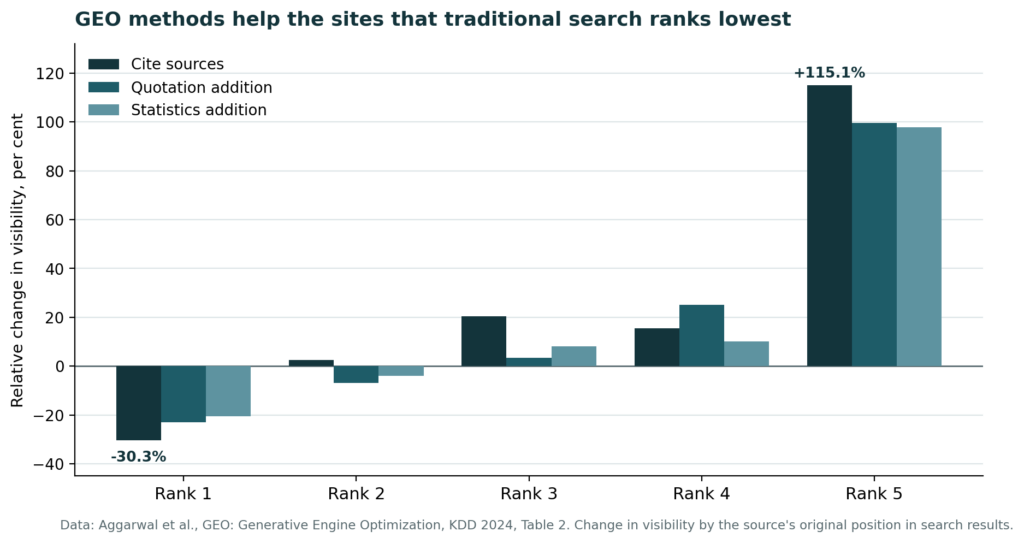
Source; Table 2 of Aggarwal et al., KDD 2024.
Where the answers actually come from
The final piece of the mechanism is the source pool itself, and it is far more concentrated than most brands assume. Semrush’s three month analysis of prompt responses found Reddit and Wikipedia leading citations across ChatGPT, Google’s AI Mode and Perplexity. Profound’s platform breakdown put Reddit at roughly forty seven per cent of Perplexity’s top cited sources, while Ahrefs’ study of nine million ChatGPT queries found Wikipedia the single most cited domain. OtterlyAI’s 2026 analysis of over one million citations found community platforms taking a slightly larger share than brand owned domains overall.
That pool is also unstable. Semrush documented ChatGPT citing Reddit in close to sixty per cent of responses in August 2025, collapsing to around ten per cent within six weeks. Visibility built on one platform’s current preferences is rented, not owned. Your intervention: earn presence across the source types engines actually read, community discussion, editorial coverage, reference material, alongside your own site, and measure across several engines rather than one.
What this means in practice
The mechanism suggests a discipline. Answer the surrounding subquestions, not just the headline query. Write in self contained, extractable sections. Carry named expertise, dates and primary data so that reranking treats your pages as evidence. Add the statistics, quotations and citations that the research shows move the final stage. And build presence in the third party sources that dominate the citation pool, because the engine’s trust in you is assembled mostly from what others say.
None of this is a trick, and that is rather the point. The systems are engineered, imperfectly but deliberately, to reward material that genuinely resolves a question. GEO, done properly, is the craft of deserving the citation and then making it easy to give.
By André Franco, Senior SEO/GEO consultant at Textbroker

7 Reddit Signals That Matter More Than Traditional SEO
1. Authentic First-Hand Experiences
AI models don’t just look for optimized pages—they prioritize authentic discussions. Reddit is full of real users sharing firsthand experiences, making these conversations highly valuable signals for AI-generated answers.
2. Community Consensus
One article can say anything. Hundreds of Reddit users independently reaching the same conclusion creates a much stronger trust signal. AI increasingly recognizes consensus as a marker of credibility.
3. Expert Participation
When recognized professionals consistently answer questions within relevant subreddits, they build topical authority that extends beyond their own websites.
4. Fresh Discussions
SEO content can remain unchanged for years. Reddit conversations evolve daily, giving AI systems access to up-to-date opinions, recommendations, and emerging trends.
5. Brand Mentions Without Links
Traditional SEO rewards backlinks. AI also pays attention to unlinked brand mentions appearing naturally across relevant discussions, especially when users recommend products or services without being prompted.
6. Context Around Your Brand
It’s not just that people mention your brand—it’s how they describe it. Reddit provides rich context: what problems you solve, who recommends you, how you compare to competitors, and what sentiment surrounds your name.
7. Quality Engagement Over Content Volume
Publishing 100 blog posts doesn’t guarantee authority. A handful of thoughtful Reddit discussions with meaningful engagement can create stronger trust signals than dozens of optimized pages.

Reddit Is Now a GEO Channel. Most Brands Aren’t Treating It Like One.
Reddit has become a primary signal source for AI generated answers. Brands that lack a managed presence on Reddit are invisible in LLM citations and are often misrepresented. This article breaks down the mechanics, the opportunity, and what a structured Reddit strategy looks like in practice.
For brands built on authentic, expert content, this is familiar territory. What earns trust on Reddit is the same thing AI systems reward, and the same thing Storylake stands for: real expertise, shared in a credible, human voice rather than marketing copy.
Why Reddit Matters for AI Visibility
Reddit is the number one source LLMs train on for opinionated, conversational data (Storylake, 2026). With 680 million monthly users and a ranking as the 6th most visited website globally, it is the most powerful single off-site channel for influencing how AI describes your brand.
When users ask ChatGPT, Gemini, or Perplexity for a purchase, comparison, or recommendation, Reddit threads are among the most cited sources. The sentiment and framing inside those threads is what AI models inherit and reproduce in their answers.
Critically, brand familiarity on Reddit is not the same as brand control. Being mentioned is table stakes. The lever for GEO (Generative Engine Optimization) is shaping how the brand is framed in threads that rank for high intent query clusters.
The numbers behind Reddit’s influence:
- 680 million monthly users
- 6th most visited website globally
- 30 to 40% higher customer LTV versus social
- LLMs trained on Reddit data
Source: Storylake, 2026
The Evolution From Mention Packages to GEO Strategy
The Reddit marketing discipline has matured significantly. Early approaches in 2024 focused on fixed monthly mention counts with basic sentiment reports. From 2025 until 2026, best in class providers shifted toward brand perception outcomes, measurable in CSAT scores (Customer Satisfaction), AI citation tracking, and share of voice across LLM outputs (Storylake, 2026).
The current integrated approach combines four pillars:
- Brand Sentiment Baseline: Establish a measurable Reddit CSAT baseline across all relevant subreddits before any engagement begins.
- AI Visibility Audit: Test key prompts across ChatGPT, Gemini, Perplexity, and AI Overviews to identify where your brand appears, how it is described, and where competitors dominate.
- Opportunity Mapping: Map the highest impact threads, topics, and subreddits where engagement creates both community trust and AI citation potential.
- Whitehat Execution: Real human accounts, native Reddit tone, and community first contributions. No AI generated text and no bots, so zero platform risk.
That last pillar is where expert led content earns its keep. Reddit rewards people who genuinely know the subject and contribute something useful, which is exactly the kind of credible, first hand knowledge that also makes a brand worth citing to an AI.
The GEO x Reddit Framework: What It Looks Like in Practice
A structured GEO x Reddit programme delivers four outputs per client:
01 AI Snapshot: how AI currently describes your brand. Competitive positioning versus rivals, decision criteria coverage (price, speed, reliability), gap identification. This is your baseline before any strategy is deployed.
02 Opportunity Map: the conversations that matter. Priority topics from user prompts, high impact thread types (recommendations, comparisons), strategic gaps where competitors dominate Reddit’s most cited threads.
03 Action Input: every mention has a purpose. Content angles and narrative focus for the execution team, comment patterns for recommendation versus comparison threads, and a clear brief aligned to AI citation goals.
04 Monthly GEO Report: measure what changes. AI visibility check (are you appearing in key prompts?), competitive movement, and decision criteria coverage evolution over time.
GEO Checklist for Reddit: Six Things to Get Right
- Audit Your Existing Reddit Sentiment: Know the current ratio of positive, neutral, and negative framing before any engagement. Preliminary data on sports apps shows sentiment as high as 70 to 80% mixed positive, but with specific friction points that AI models also pick up and cite.
- Map the Threads That Rank: Identify which Reddit posts appear in Google or Bing results for your target query clusters. Those are your GEO insertion points, not random threads.
- Prioritize Comparison and Recommendation Threads: “X vs Y” and “best app for Z” threads are highest probability AI citation sources. Prioritize strategic presence in these over general brand mentions.
- Use Platform Native Language: Promotional tone gets downvoted and algorithmically reweighted. Authentic, specific, community first language earns upvotes and becomes a persistent signal in LLM training sets.
- Guarantee Mentions Volume With MoM Scaling: 7 to 12 monthly mentions is a reasonable starting baseline. Volume should compound month on month as community presence grows and karma builds.
- Report on Sentiment Deltas, Not Mention Counts: Mention counts are a vanity metric for GEO. The metric that matters is the ratio shift in how your brand is characterized, tracked via CSAT scoring and prompt response analysis across AI platforms.
Find Out How Your Brand Is Positioned on Reddit Right Now
A Reddit sentiment and AI visibility audit tells you what AI models are reading about your brand today, and where the gaps are between your intended positioning and what communities are actually saying. It is the starting point for any serious GEO strategy, and the foundation for the kind of authentic, expert content that both Reddit communities and AI systems reward.