


A four-way self-diagnosis before you call anyone
“Our brand doesn’t show up when people ask ChatGPT for a recommendation” is not one problem. It’s four.
They look identical from the outside. The same blank space where your name should be. However, on the inside, each has a different cause and a different fix. Pouring months into content when your real problem is a firewall rule is a waste. So is rewriting your robots.txt when the model simply doesn’t know your company exists.
Before you hire anyone (including us), you can find out which of the four you’re dealing with in about ten minutes. You need a ChatGPT account where you can toggle web search on and off, and the willingness to ask it the questions your buyers actually ask. Work down the tree in order. Each check clears one layer before you move to the next, so you never end up fixing the wrong thing.
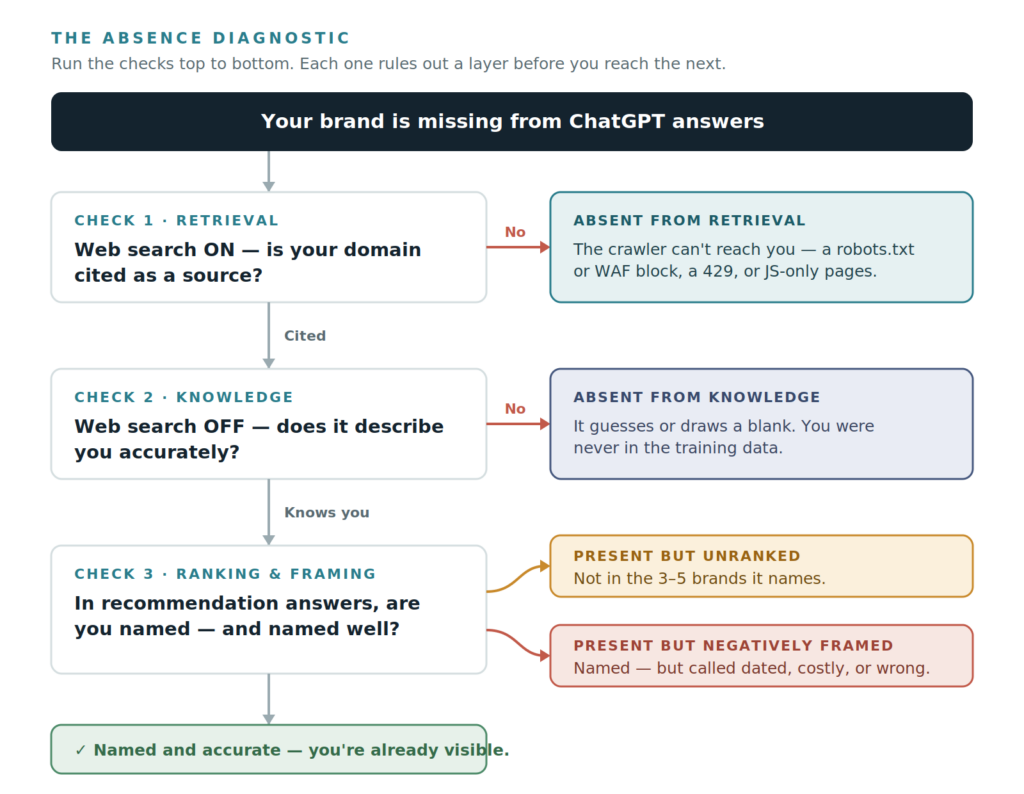
Figure 1: The absence diagnostic. Run the three checks in order; each rules out a layer before you reach the next. Source: Storylake
Check 1: Can it even reach you?
Turn web search on. Ask the real buyer query (e.g. “best [category] for [use case]”) and read the citations underneath the answer. If your domain never appears as a source across any relevant prompt, the model isn’t choosing to leave you out. It can’t reach you. This is plumbing, and it’s the most common cause by a wide margin.
ChatGPT reaches sites through three separate OpenAI crawlers, each with a different job: GPTBot handles model training, OAI-SearchBot builds the search index behind citations, and ChatGPT-User fetches a page live when the model needs it. The one that governs whether you appear in search answers is OAI-SearchBot — and OpenAI’s own publisher guidance is blunt: block it and you won’t show up in ChatGPT search. Plenty of sites block it by accident, a leftover from the 2023 reflex to bar every AI bot.
An open robots.txt won’t save you if your firewall does the blocking instead. The classic trap: the crawler is technically allowed, but a Cloudflare or WAF rule returns 429 Too Many Requests, so OpenAI quietly drops you.. Two more culprits are near-universal: OAI-SearchBot and ChatGPT-User don’t reliably execute JavaScript, so content that renders only client-side is invisible to them; and noindex or nosnippet tags make a page impossible to quote.
Where retrieval actually pulls from is deliberately murk. OpenAI blends its own index with licensed search partners, and the Bing-versus-Google mix has shifted enough that any confident “it’s just Bing” claim is now outdated. The practical version is simpler: allow OAI-SearchBot and ChatGPT-User, clear the WAF and rate-limit traps, server-render your key pages, and make sure you’re indexed in both Bing and Google. One reassuring nuance: being indexed matters far more than ranking first. This is the one branch where you can move the needle in a day.
Check 2: Does it know you at all?
If you are getting retrieved but still losing, turn web search off and ask: “What is [your brand] and what does it do?” If it invents an answer, confuses you with a competitor, or admits it doesn’t know, you’re not in the model’s parametric memory.
This is the hardest gap to close, because you can’t optimize your own website into it. Models learn brands from the wider web, and the concentration is stark: in Ahrefs’ analysis of 75,000 brands, Reddit, Wikipedia, Amazon, Forbes and Business Insider rank among ChatGPT’s most-cited domains, i.e., the places the model reads to decide who you are. The same research found a brutal winner-takes-all curve in Google’s AI Overviews: 26% of brands had zero mentions, and any brand sitting in the bottom half of web mentions was, in Ahrefs’ words, essentially invisible. Brands in the top quartile of web mentions averaged 169 AI Overview mentions, more than ten times the quartile below them.
So the fix is a slow signal-density game: earn mentions where the models actually read (e.g. editorial coverage, review platforms, Reddit, reference-grade sources) and future training runs pick you up. It also explains why Check 1 matters so much in the meantime. Retrieval is your only route into today’s answers while the training data catches up.
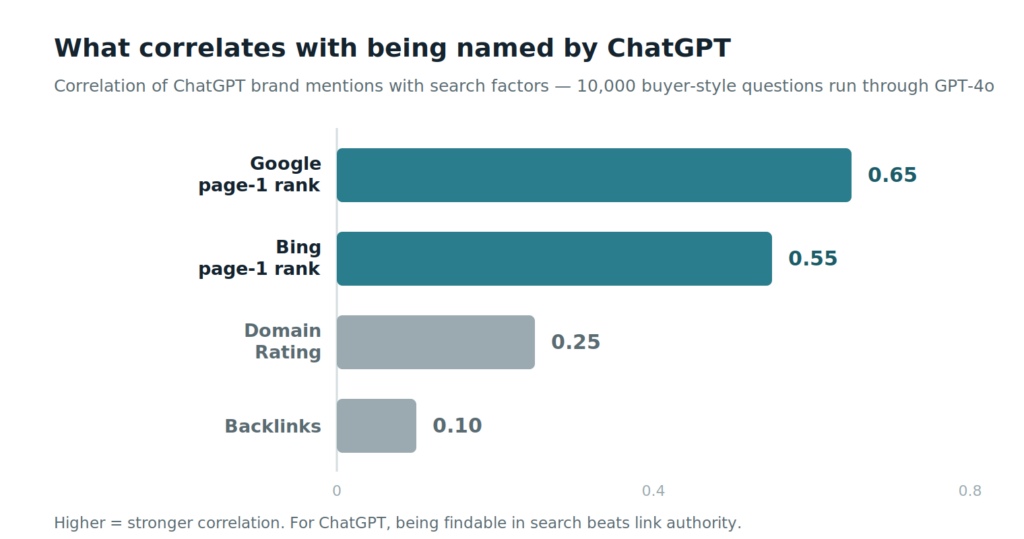
Figure 2: For ChatGPT specifically, ranking on page one of Google (~0.65) and Bing (~0.55) correlates with brand mentions far more than domain rating or backlinks.
Source: Seer Interactive, “What Drives Brand Mentions in AI Answers,” January 2025 (10,000 questions via the GPT-4o API).
Check 3: Are you named, and named well?
If the model can retrieve you and knows who you are but you’re still absent from the recommendation, the problem is competitive and splits in two smaller issues:
Present but unranked
LLMs surface only a handful of brands per answer, and getting onto that short list is the game. The encouraging news for ChatGPT specifically: it’s more meritocratic than you’d expect.
When Seer Interactive ran 10,000 buyer-style questions through the GPT-4o API, the strongest correlate of being named wasn’t domain authority or backlinks, it was ranking on page one of Google (~0.65) and Bing (~0.55). ChatGPT tends to name brands that are already findable in ordinary search, not the ones with the biggest link profiles.
On the content side, the Princeton-led GEO study (KDD 2024, with Georgia Tech, IIT Delhi and the Allen Institute for AI) tested nine tactics across 10,000 queries and found the single most effective one was adding specific statistics, which lifted visibility in generative answers by up to roughly 40%. Ahrefs’ AI Overviews data points the same direction: branded web mentions out-predicted backlinks about three to one. The through-line is consistent: get findable in search, get discussed off-site, and be specific enough to quote.
Present but negatively framed
Sometimes you’re named, and it hurts. The model calls you “expensive,” “hard to set up,” or references a feature you retired two years ago.
Here is the uncomfortable finding: When Ahrefs invented a fake brand and seeded the web with three conflicting stories about it, most assistants swallowed the fiction: Gemini and Perplexity repeated the planted falsehoods in 37–39% of answers. ChatGPT held up best — under 7% — because it leaned on the brand’s official FAQ in 84% of its answers. The lesson lands hard: when forced to choose between a vague truth and a specific fiction, AI picked the specific fiction almost every time. If your own pages say “we don’t disclose pricing” and a competitor’s comparison names a number, the number wins.
That points straight to the fix. Fill every gap with specific, official content: an FAQ that states plainly what’s true and false (“we’ve never been acquired”), backed by real dates, numbers and schema markup. Claim specific superlatives (e.g. “best for [use case],” “fastest at [metric]”) rather than generic “industry-leading” language that AI averages into noise. Then monitor how each model describes you, because there’s no single “AI index”: the version of you in Perplexity can differ from the one in ChatGPT, and you fix each at its own source.
The pattern under all four: specificity wins
Read across every credible study and one thread runs through all of them. Adding statistics beat every other content tactic. Specific fiction beat vague truth. Findable, quotable pages beat big backlink profiles. The brands that win AI answers are always the most specific credible source on the question being asked. Vagueness is the real enemy: leave a gap, and the model fills it with whoever was more precise, even when they’re wrong.
The same empty space has four causes, and they run on different clocks. A retrieval block clears in a day. A knowledge gap takes quarters. Ranking and framing sit in between, and both reward the same durable work: being genuinely findable, quotable, and specific in the places these models read.
Run the three checks in order and you’ll know which problem you’re actually solving before you spend a dollar on the wrong one. If you get to the bottom and want a second pair of eyes on the fix. That’s where we, Storylake, come in to help you out.
By André Franco, Senior SEO/GEO consultant at Textbroker


