


Most explanations of generative engine optimisation describe outcomes. Get cited. Be the answer. Win the recommendation. Very few describe the machinery that produces those outcomes, which is a problem, because you cannot influence a system you do not understand. This guide walks through what actually happens between a person typing a question into ChatGPT, Perplexity or Google’s AI Mode and a brand appearing, or not appearing, in the answer. At each stage, we name the intervention available to you.
Our starting premise at Storylake is simple: AI systems do not rank websites. They cite sources they trust. Everything below is an explanation of how that trust is established, mechanically, stage by stage.
What is generative engine optimisation?
Generative engine optimisation, usually shortened to GEO, is the practice of increasing the likelihood that an AI system mentions, recommends or cites your brand when it generates an answer. The term comes from a 2024 academic paper by Aggarwal and colleagues at Princeton, presented at the KDD conference, which tested which content changes measurably improve visibility inside AI generated answers. It differs from classic SEO in what it optimises for: not a position on a results page, but inclusion in a synthesised answer.
You will also see the phrase answer engine optimisation, or AEO. The cleanest way to separate the two: AEO is about structuring content so that machines can extract an answer from it, while GEO is the broader discipline of earning presence across everything an AI system reads, including sources you do not own. AEO is a subset of GEO. Both sit on top of SEO, because a page must still be found before it can be read.
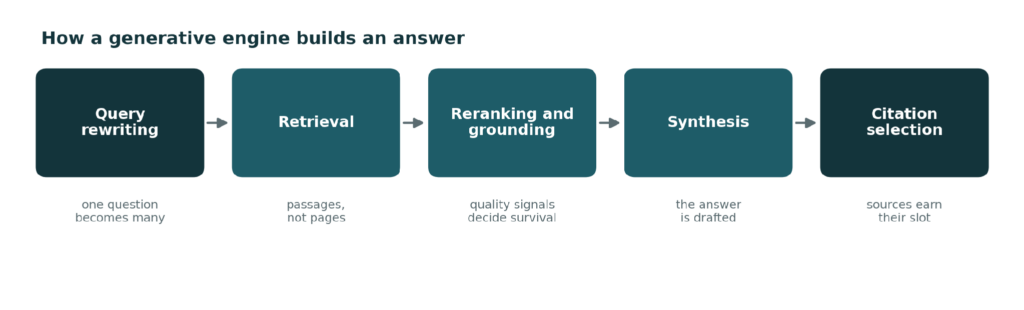
Source: Aggarwal et al. (KDD 2024, Figure 2)
Stage one: the question is rewritten before anything is searched
When a person asks an AI system a complex question, the system rarely searches for that question. It decomposes it. Google calls this query fan out, and has described it openly: AI Mode issues multiple related searches at once, across subtopics and data sources, before it writes a word. A patent application filed by Google, US20240289407A1, describes a system in which a language model generates a set of synthetic queries that explore different facets of the original question. Industry analyses consistently observe a single seed question expanding into roughly eight to twelve subqueries covering comparisons, specifications, pricing, alternatives and likely follow ups.
The practical consequence is significant. The keyword you rank for is not the only string the engine searches. Content can be pulled into an answer because it happened to be the best response to one hidden subquery, which is why pages from deep in traditional results sometimes surface in AI answers. Your intervention here: map the subquestions that surround your topic and answer each one explicitly, rather than writing one page that gestures at all of them.
Stage two: retrieval happens at passage level, not page level
The expanded queries are run against an index, but modern retrieval does not match keywords to pages. Queries and content are converted into vector embeddings, mathematical representations of meaning, and the system pulls the passages that sit closest to each subquery in that space. The unit of competition is a chunk of text, typically a few hundred words, not your domain and not your page.
This is why we tell clients that a brilliant answer buried in paragraph nine is invisible. Your intervention: make every section of a page independently useful. A heading that states the question, followed by two or three sentences that answer it completely, followed by the supporting evidence. If a two hundred word slice of your page cannot stand alone, it will struggle to be retrieved.
Stage three: reranking and grounding decide what survives
Retrieval casts a wide net. A second pass then reranks the retrieved passages for relevance, quality and trustworthiness, and the surviving passages are placed into the model’s working context. This grounding step is where quality signals bite. Rerankers trained on human relevance judgements consistently downweight text that reads as sales copy when the question is informational, which is why product pages and homepages make up only a low single digit share of cited URLs in analyses of ChatGPT sessions.
Your intervention: publish reference material, not persuasion. Declarative claims, named authors with verifiable credentials, dated and versioned content, and primary data nobody else holds. Pages that behave like evidence survive reranking. Pages that behave like advertising do not.
Stage four: the answer is written and sources earn their citations
Only now does generation happen. The model drafts an answer from the grounded passages and attaches citations to some of them. The Princeton study is the best public evidence on what wins this final stage. Testing nine content strategies across ten thousand queries, the researchers found that adding statistics, quoting relevant sources and citing external evidence each lifted visibility in generated answers by roughly thirty to forty per cent. Keyword stuffing, the reflex of old SEO, performed poorly.
One finding deserves particular attention. The benefits were largest for sources that traditional search treats worst. In the Princeton data, a site ranked fifth in conventional results saw its visibility inside AI answers rise by 115.1 per cent from citing sources alone, while the top ranked site lost 30.3 per cent. Generative engines condition on the content itself more than on accumulated domain authority, which means clearly structured, well evidenced writing can compete against incumbents in a way it never could on a results page.
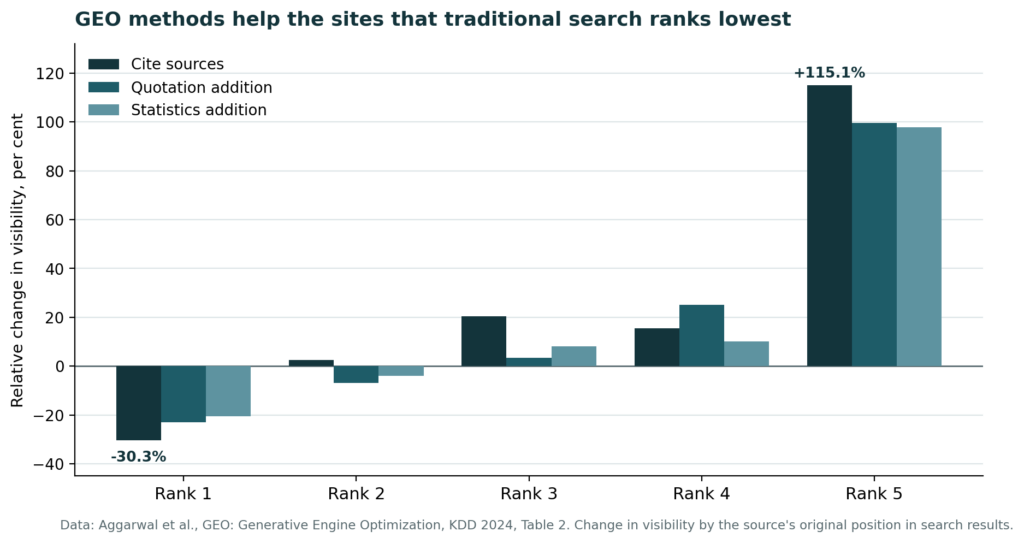
Source; Table 2 of Aggarwal et al., KDD 2024.
Where the answers actually come from
The final piece of the mechanism is the source pool itself, and it is far more concentrated than most brands assume. Semrush’s three month analysis of prompt responses found Reddit and Wikipedia leading citations across ChatGPT, Google’s AI Mode and Perplexity. Profound’s platform breakdown put Reddit at roughly forty seven per cent of Perplexity’s top cited sources, while Ahrefs’ study of nine million ChatGPT queries found Wikipedia the single most cited domain. OtterlyAI’s 2026 analysis of over one million citations found community platforms taking a slightly larger share than brand owned domains overall.
That pool is also unstable. Semrush documented ChatGPT citing Reddit in close to sixty per cent of responses in August 2025, collapsing to around ten per cent within six weeks. Visibility built on one platform’s current preferences is rented, not owned. Your intervention: earn presence across the source types engines actually read, community discussion, editorial coverage, reference material, alongside your own site, and measure across several engines rather than one.
What this means in practice
The mechanism suggests a discipline. Answer the surrounding subquestions, not just the headline query. Write in self contained, extractable sections. Carry named expertise, dates and primary data so that reranking treats your pages as evidence. Add the statistics, quotations and citations that the research shows move the final stage. And build presence in the third party sources that dominate the citation pool, because the engine’s trust in you is assembled mostly from what others say.
None of this is a trick, and that is rather the point. The systems are engineered, imperfectly but deliberately, to reward material that genuinely resolves a question. GEO, done properly, is the craft of deserving the citation and then making it easy to give.
By André Franco, Senior SEO/GEO consultant at Textbroker


